Author: Nuha Khan
In May 2024, the Serbian and Albanian football federations submitted a joint bid to host the 2027 mens’ U-21 European Championship. Having been the only ones to meet the deadline to submit a detailed plan, UEFA announced on September 26 that the two countries are set to host the tournament. Despite deep rooted political and social tensions between the Balkan states, this joint venture may have the capacity to encourage positive diplomatic and inter-ethnic relations.
Historic Tensions
While tensions between ethnic Serbs and Albanians have existed for centuries, the 1998-1999 Kosovo War can be used to understand the social tensions among the two groups. During the conflict, Serbian President Slobodan Milosevic stripped Kosovo – which is more than 90% ethnic Albanian – of its autonomy and placed it under Belgrade’s direct rule. This, along with numerous other factors, prompted fighting between Serbia and Kosovar Albanians. NATO then launched a 78-day war to stop the killing of ethnic Albanians by Serbia.
As the states prepare to host the 31-games tournament, let us take a look at a previous football incident between Albania and Serbia and how it reflected ongoing political strife.
Violent Clashes On The Pitch
During a 2016 Euro Championship qualifying match in 2014, as the Serbian and Albanian mens’ national teams met for the first, decades of anger between the two countries were appallingly displayed on the pitch. During the 41st minute of the match, an uncanny drone hovered above the FK Partizan stadium in Belgrade. With it, a banner flew depicting an image of “Greater Albania”, a concept involving anywhere Albanians reside – including Kosovo, whose statehood is not recognized by Serbia. The Serbian defender Stefan Mitrovic tore down the flag while his side’s fans immediately filled the pitch attacking Albanian players. Flares were thrown onto the pitch as police in riot gear prepared to break up the violent crowd. Needless to say, the match was canceled.
Nine months later, the Court of Arbitration of Sports ruled that Serbia was responsible for ending the game and awarded Albania with a default 3-0 win. Three points were also deducted from Serbia and the country was ordered to host two matches in an empty stadium (The Guardian). UEFA also ordered both football federations to pay fines of 100,000 euros.
While the 2014 match in Belgrade was a competition for a spot in the UEFA Championship, the riot that ensued was a physical reflection of the political competition over Kosovo – which is claimed by both ethnic Albanians and Serbians.
Looking Forward
Looking to the 2027 U-21 UEFA Championship, Serbia and Albania have the opportunity to merge their resources and populations to work together to prepare for a smooth tournament. One that attempts to lessen political and ethnic tensions. As Armand Duka, head of the Albanian Football Federation stated stated, “it’s a 100% football project” with “a very good political message that we can get across.” While it is only a U-21 tournament, the political context of the 2027 edition can enable it to be either another rendition of Belgrade 2014 or an illustration of the ability of sport to bridge divides and strengthen international diplomacy.
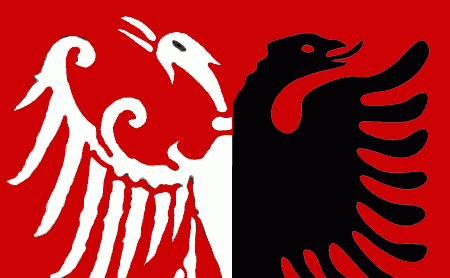
Image Credit: “Serbian-albanian-eagle.gif” by Mladifilozof via Wikimedia Commons, CC BY-SA 3.0.
 Goal Diplomacy